.svg)
AI’s Energy Challenge Is Solvable
What’s driving AI energy demand, what’s actually at stake, and how better power literacy can keep growth aligned with the grid. AI is changing the energy profile of data centers, but the central story does not have to be one of inevitability. Data centers accounted for about 1.5% of global electricity use in 2024, and the IEA expects demand to rise meaningfully by 2030 as AI scales. That is enough to matter for grids, communities, and operators, but it is also a scale where measurement, efficiency, and better software can make a real and meaningful difference. But exactly how big is the AI and energy challenge we’re facing, and what would it take to grow AI in a way that is measurably more efficient and responsible? We dive into some of the most pressing questions being asked about AI today.
Q1. Why is AI’s energy use in the headlines?
AI is adding a new layer of demand to a power system that already has to balance cost, reliability, and decarbonization. Recent estimates suggest that global data center electricity use could roughly double by 2030, from around 460 TWh in 2022 to close to 1,000 TWh, with AI accounting for a large share of that additional demand.
But one of the biggest reasons AI’s rapid growth is getting attention is not just total electricity use; it is the speed of growth, the power density of AI facilities, and the fact that many of these workloads are “always on”. AI’s rapid expansion is no longer only a question of model performance, it is also about where and how we secure power and how well the surrounding infrastructure can support it.
Q2. Is this an AI problem, an energy problem, or both?
It is both. In some regions, utilities and analysts expect data center demand to grow by more than 20 - 30% in just a few years, which is much faster than typical grid expansion timelines. AI is driving more compute, more inference, and more high‑density deployment, while the energy system must absorb that demand within the limits of generation, transmission, and local infrastructure. The tension shows up when AI growth moves faster than power planning.
The outcome is not fixed, though. There are already practical levers to reduce energy use, such as more efficient hardware, power caps, smarter training and inference, workload shifting, and software that adapts to grid conditions. The challenge is solvable because a meaningful share of it is operational.
Even with rapid growth, data centers are still a relatively small share of total electricity use globally, and they are not overwhelming the grid today. They are, however, becoming large enough to demand more disciplined planning, better transparency, and smarter ways of using the power that is already available.
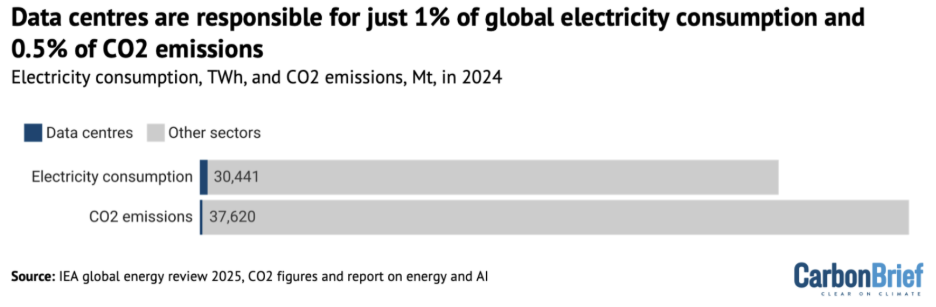
Data centers account for just 1 percent of global electricity consumption and 0.5 percent of CO2 emissions. This is currently a meaningful but proportionate share of global energy use, but one that demands efficiency now before growth changes the math.
Q3. How much energy does AI actually use?
There is no single number to quantify energy usage, because the energy cost of AI depends on the model, the hardware, the query type, and how the workload is scheduled. But some comparisons help make the scale more tangible: processing a million tokens can produce carbon emissions comparable to driving a gas‑powered car five to twenty miles, and generating a single image can consume energy similar to charging a smartphone.
A single query may not seem significant on its own, but at scale those interactions add up quickly. Making sense of that scale means distinguishing between two related ideas. Energy, measured in kilowatt‑hours, describes how much work AI does over time. Power, measured in kilowatts or megawatts, describes how hard AI is pulling on the grid at any given moment. Many of the most expensive grid upgrades and a large share of utility costs are driven less by total energy use than by peak demand — the brief moments when everything is running at once.
That is why the most useful lens is not simply how much energy AI uses overall, but how much energy each unit of useful work requires and what that pattern does to peak power draw. Once those numbers are visible and tracked at the workload level, they become inputs for designing more efficient systems, making smarter infrastructure and siting decisions, and showing that AI’s energy footprint is being managed and improved over time rather than simply growing unchecked.
Q4. How big is the challenge in the grand scheme of things?
It is very real, but can be misinterpreted when viewed without context. Data centers are not consuming most of the world’s electricity, AI does not make every workload equally energy‑intensive, and a small, occasional query is not the same as a large, always‑on model running continuously.
Research suggests there is significant headroom to improve the efficiency and impact of AI data centers. Simple changes such as capping power draw instead of running hardware at full tilt, right‑sizing models and training runs, and shifting flexible jobs to better times or regions could shave 10% to 20% off global data center electricity demand. That is a hopeful signal that there is room to grow AI without assuming the only answer is more power, more infrastructure, and more strain.
These are strategies that exist today and can be implemented for cost savings, lower environmental impact, and smoother operations at the same time. In many cases they are not tradeoffs against performance, but enhancements to how AI is managed across the board, which is a hopeful signal that there is room to grow AI without assuming the only answer is more power, more infrastructure, and more strain.
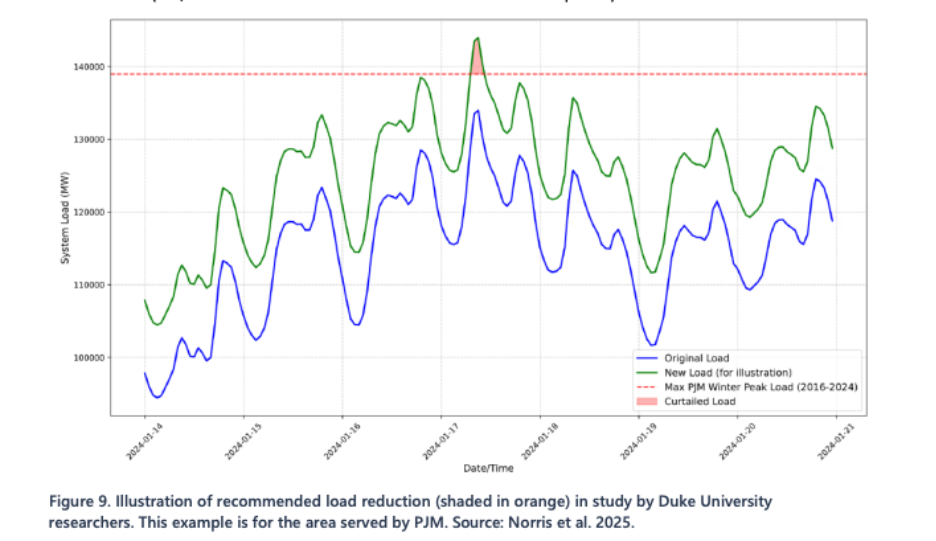
ACEEE: When data centers flex their demand intelligently, they stay below the grid's peak load threshold without sacrificing operations.
Q5. If these solutions exist today, what can operators do now to improve efficiency?
For operators, the real opportunity is in shaping demand, not in buying more power, with the biggest gains coming from how workloads are scheduled and managed. Operators can cap power to avoid running every system at maximum draw, use more efficient hardware, and reduce overprovisioning. Teams can also adopt training and inference approaches that avoid unnecessary compute and use software to shift non‑urgent work to better times or regions where the grid is less constrained and cleaner.
Many operators are already improving facility‑level efficiency using Power Usage Effectiveness (PUE), a standard metric for how effectively a data center turns incoming power into usable compute. Improving PUE still matters because it shows how well a site is designed and run, but it does not reveal how efficiently AI workloads are using that capacity. Because of this, operators are increasingly pairing PUE with workload‑level metrics like energy per query or per training run.
These shifts improve energy per unit of AI work while keeping systems performant. In some cases they can even make compute faster and more predictable. The common thread is that they work best when an intelligence layer can see workloads and power constraints together and decide what runs where and when, so a fixed power envelope goes further.
Q6. If PUE is only part of the picture, how should AI efficiency really be measured?
PUE is like the plumbing of the data center; it shows how well power gets to the servers but it does not show how intelligently that power is used once it arrives. For AI, the real question is how much useful work is delivered for the energy and peak power drawn from the grid. Instead of stopping at how efficiently a facility delivers power to servers, it helps to look at how much useful AI work those servers produce for the energy and capacity they use. In practice, that often looks like tracking tokens per grid kilowatt‑hour and tokens per grid kilowatt.
Framing efficiency this way keeps the focus on outcomes, not just infrastructure. PUE still has a role in showing how well a site is designed and run, but it becomes a supporting metric. What matters most is how much intelligence a constrained grid connection can actually deliver.
Q7. What about communities and local grids?
That concern is real, and it should be taken seriously. Large AI data centers can affect transmission capacity, local energy prices, water use, land use, and permitting timelines, especially when growth arrives faster than surrounding infrastructure can adapt. The issue is not just how much energy AI uses in total, but where that energy is drawn from, how carbon‑intensive that grid is, and who feels the strain first.
The most constructive response is greater visibility and better planning. If operators can measure workloads precisely, understand the carbon intensity of the grids they rely on, and shift unnecessary load in time and location, they can reduce pressure on local systems, lower emissions at the margin, support utility coordination, and make their expansion easier to explain to communities. That is how energy efficiency becomes a societal benefit, not just an internal cost saver.
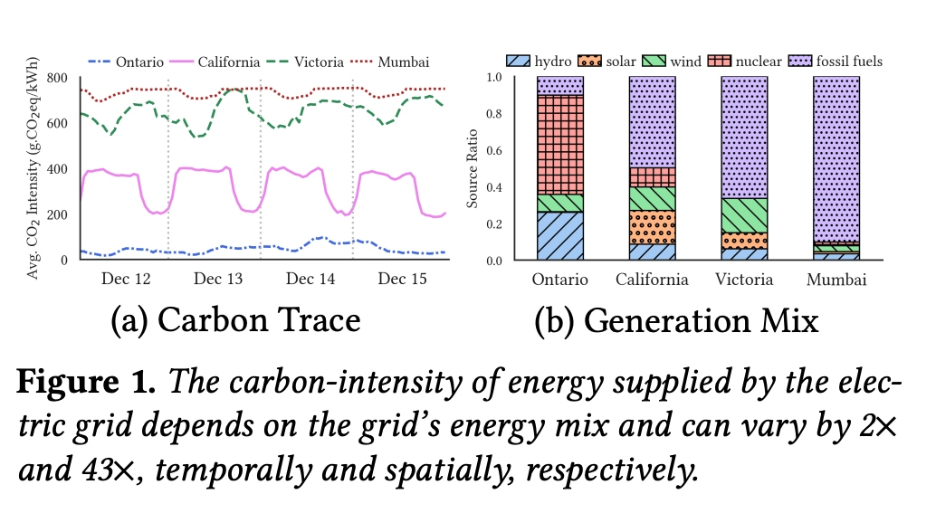
UMass Amherst: Carbon intensity varies depending on where and when a workload runs. This is exactly why location-aware routing and real-time grid data matter.
Q8. How should companies think about energy reporting as AI grows?
As AI scales, energy reporting must move beyond broad facility totals toward a clearer view of how much energy different AI workloads use. The most useful approach is to treat energy reporting as a set of operational metrics, not just an annual compliance task: tracking measures such as energy per query, per training run, or per unit of AI output, and using those trends to set concrete efficiency targets.
When that level of detail is available, it becomes easier to see how much intelligence is being delivered for the energy and peak power drawn from the grid, to prioritize which workloads to optimize, and to plan growth within real power limits. Done well, energy data turns reporting from a static obligation into a tool for making smarter decisions, targeting the biggest efficiency gains first, and building trust with stakeholders.
Q9. Can AI growth and environmental goals actually coexist?
Yes, if efficiency is built into the operating model rather than treated as an optional extra. AI will use energy, but the question is whether that energy is being used well. When teams measure carefully, optimize aggressively, and schedule intelligently, they can reduce waste without sacrificing performance.
That creates a better outcome for everyone involved. It can mean less strain on grids, lower emissions where cleaner power is available, and a more credible path for scaling AI without ignoring environmental limits.
Q10. Is any of this being put into practice yet?
Yes. A growing group of operators are already redesigning where and how they build AI capacity to make better use of the energy system around them. Some are building new facilities in regions with abundant renewable resources and pairing that demand with long‑term wind and solar projects.
Others are experimenting with “energy‑first” designs that colocate data centers with stranded or constrained generation, so a larger share of AI workloads run on energy that would otherwise be wasted. Companies like Crusoe and Panthalassa are building flexible, energy‑aware data centers that tap waste‑to‑compute and surplus renewables, adjusting usage with grid conditions so that hard‑to‑use power becomes useful computation. There are also operators investing in advanced cooling, flexible load management, and participation in grid‑service and demand‑response programs, so that facilities can adjust usage up or down with local conditions instead of adding to peaks.
Taken together, these efforts show that location decisions, renewables, and power‑efficiency software are already being used to make compute more constructive for local grids, and not just an added source of strain.
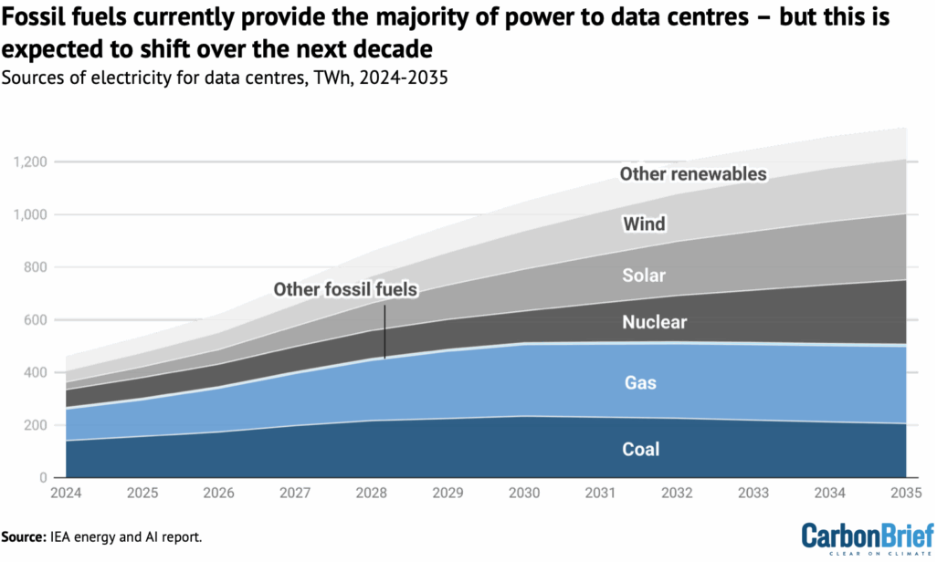
Fossil fuels currently power the majority of data centers, but the mix shifts significantly toward renewables and nuclear by 2035. The transition is already underway, and efficiency matters as we make that transition.
Q11. Where can organizations start if they want to measure and reduce the energy and carbon footprint of their AI workloads today?
For organizations running inference, Neuralwatt Cloud returns real-time energy and carbon data on every API call, making energy and emissions visible at the workload level from day one. Every request shows exactly what it consumed, what it cost, and what it contributed to grid emissions, so teams can make smarter decisions about model selection, workload scheduling, and infrastructure spending.
For organizations running their own GPU infrastructure, Neuralwatt Optimize sits alongside existing hardware, continuously tuning power consumption. In production environments, customers have achieved 33 percent more compute from their existing power envelopes without adding new hardware, reducing energy costs, lowering emissions, and unlocking capacity.
Both products include full energy and carbon reporting, exportable data, and a methodology that is publicly documented and auditable.
AI’s energy challenge is legitimate, but the industry already has the tools to measure more precisely, optimize more intelligently, and make better use of the power it has.
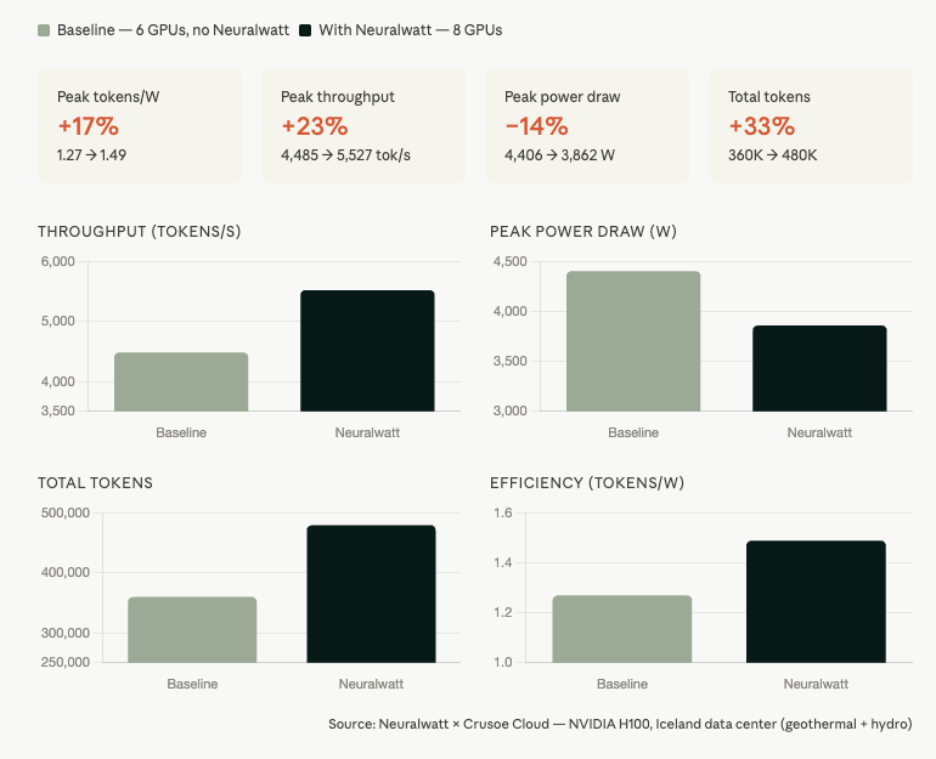
More output and less energy: Neuralwatt delivered 23% more peak throughput and 33% more total tokens on Crusoe Cloud's NVIDIA H100 clusters while reducing peak power draw by 14%.
Sources: