.svg)
Our Mission
Backed by the Best






Our Team





In The News
If you believe AI should be built responsibly, share this. The decisions being made in the next eighteen months will outlive every model we’re excited about today, and the communities carrying their cost deserve proof that the capacity was necessary.
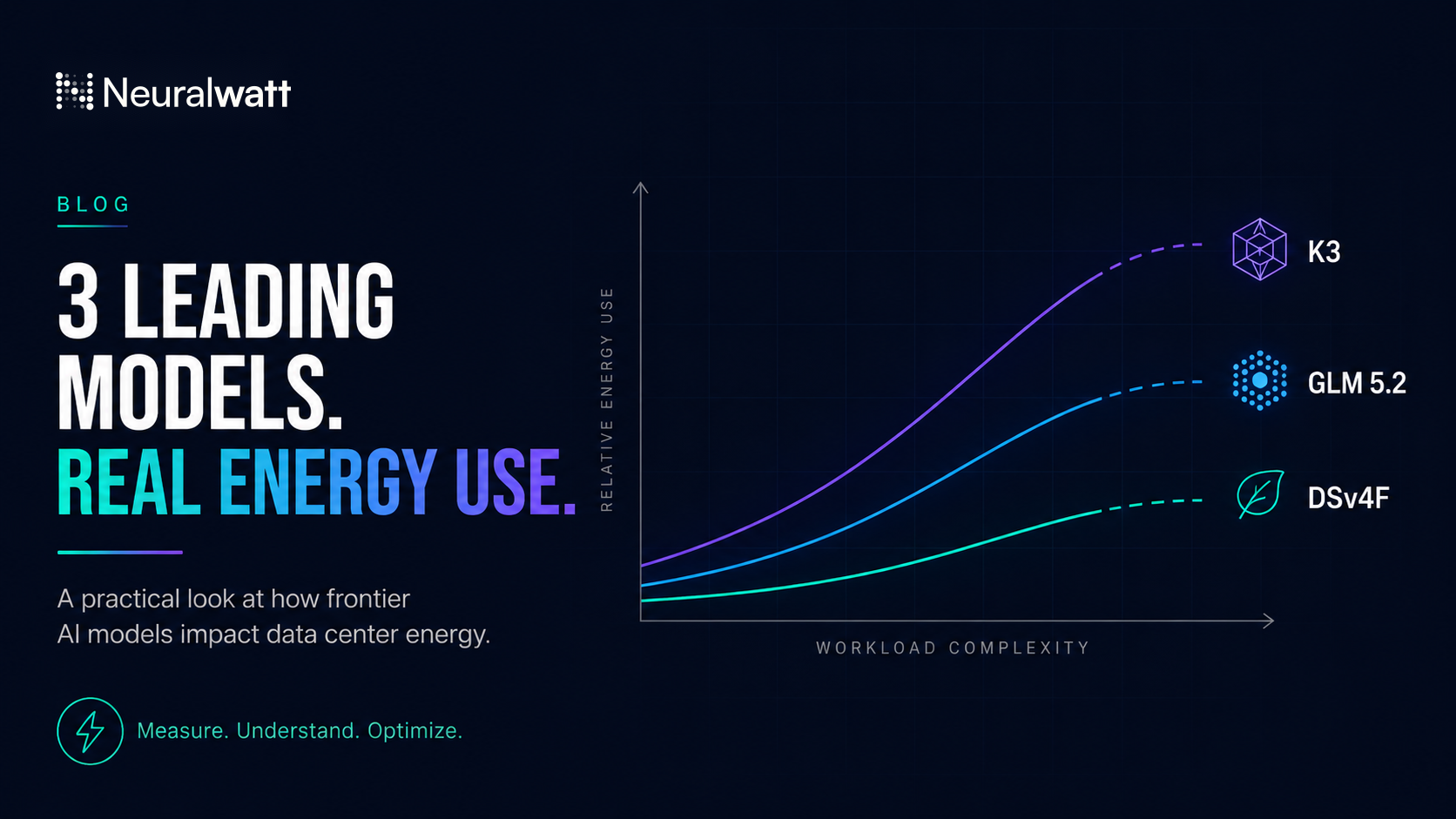
We review real world energy insights from the latest open weight models on Neuralwatt Cloud.
For the most part, the industry's answer to AI's growth has been more. More data centers, more power, more scale. Gigawatts of new demand, billions in new construction, and a race to secure capacity that treats energy as an asset to acquire rather than an asset to manage.
But scale that only the biggest players can afford isn't the future of AI, it's the bottleneck. When we launched Neuralwatt, we started from a different conviction — AI grows farther, faster, and more responsibly when the power we already have works harder, and when the economics work for everyone building with it. When you measure energy and optimize it, cost, performance, and sustainability stop pulling against each other. Six months into 2026, and our thesis is holding.
Developers proved the demand.
In March, we launched Neuralwatt Cloud featuring energy-based pricing, one of the only platforms in the industry to price AI this way. Instead of paying for an arbitrary token count, you pay for the actual compute your request uses. Leaner models and smarter prompts cost less, and efficiency benefits those building with AI. Since launching Neuralwatt Cloud, inference volume has doubled month over month, evidence of a market that has been waiting for AI to be priced honestly.
Energy-based pricing also means every team pays for what their requests actually consume, and our new Allowance feature keeps that spend exactly where you set it, with built-in limits by key, session, or agent. For enterprises, that means precision and predictability at scale. And for the developers and startups building on open-weight models, AI becomes affordable at any size.
Responsibility at scale.
Pricing AI honestly solves one problem. Making sure the infrastructure can sustain it solves the next one. This year, we tested that at the hardware level. In partnership with ZutaCore, we ran nearly 500 paired experiments on NVIDIA's latest B200 hardware, one of the industry's first studies to optimize compute and cooling together. The results yielded:
- 18 - 19% lower server power at every temperature tested
- Zero thermal throttling across the full 28 to 46°C range
- 3x better power stability
- Proof that the 45°C warm-water cooling approach NVIDIA is designing its next-generation Vera Rubin platform around works on current hardware today
The results proved that the efficiency assumptions underpinning the industry's next generation of data centers aren't speculative --- they're achievable now, with Neuralwatt software, on hardware that's already deployed.
In June, we also extended our visibility from energy to emissions, launching real-time carbon reporting built on live grid data from our partners at Electricity Maps. Every request on Neuralwatt now returns its energy, carbon, and cost as it runs, turning what has always been an annual estimate into a live number teams can use to report credibly and reduce emissions in real time.
The industry took notice.
One of the strongest signals of the past six months isn't just what we shipped, but who we worked with.
Hugging Face engaged us on their AI Energy Score, expanding energy benchmarking to cover reasoning models. The collaboration proved that energy is becoming a standard dimension of how AI models get evaluated, and we're helping write the standard.
GreenPT integrated our measurement to make AI's hidden energy costs visible to their users, Parasail incorporated our energy intelligence to work across their inference fleet, and the Sijbrandij Foundation named Neuralwatt a launch partner of the Data Center Power Coalition — twelve energy companies working to streamline how AI gets powered.
The Green Web Foundation also celebrated Neuralwatt as a model of a transparent, sustainable cloud service, one of the only AI platforms that prices by energy rather than tokens. And in April, we took the conversation directly to the builders, joining the OpenClaw community at ClawShop, their largest virtual event to date, to talk about what AI agents actually cost to run.
The way AI scales is being decided now.
The first half of 2026 confirmed that energy is becoming the defining constraint of the AI era. The grid can't grow as fast as demand, communities are pushing back on new construction, and regulators are demanding emissions data most of the industry can't produce. To boot, the pressure lands hardest on those with the least room to absorb it — small teams priced out of compute, neighborhoods carrying grid strain, and organizations that can't produce the numbers being asked of them.
In the second half of the year, we'll add more models to the platform, give users more ways to optimize cost and performance through Flex, and push optimization deeper into every request. Open-weight models have democratized access to AI; our work is making sure the energy and the economics let it grow responsibly.