.svg)
Neuralwatt and ZutaCore Prove AI Infrastructure Can Do More With Less
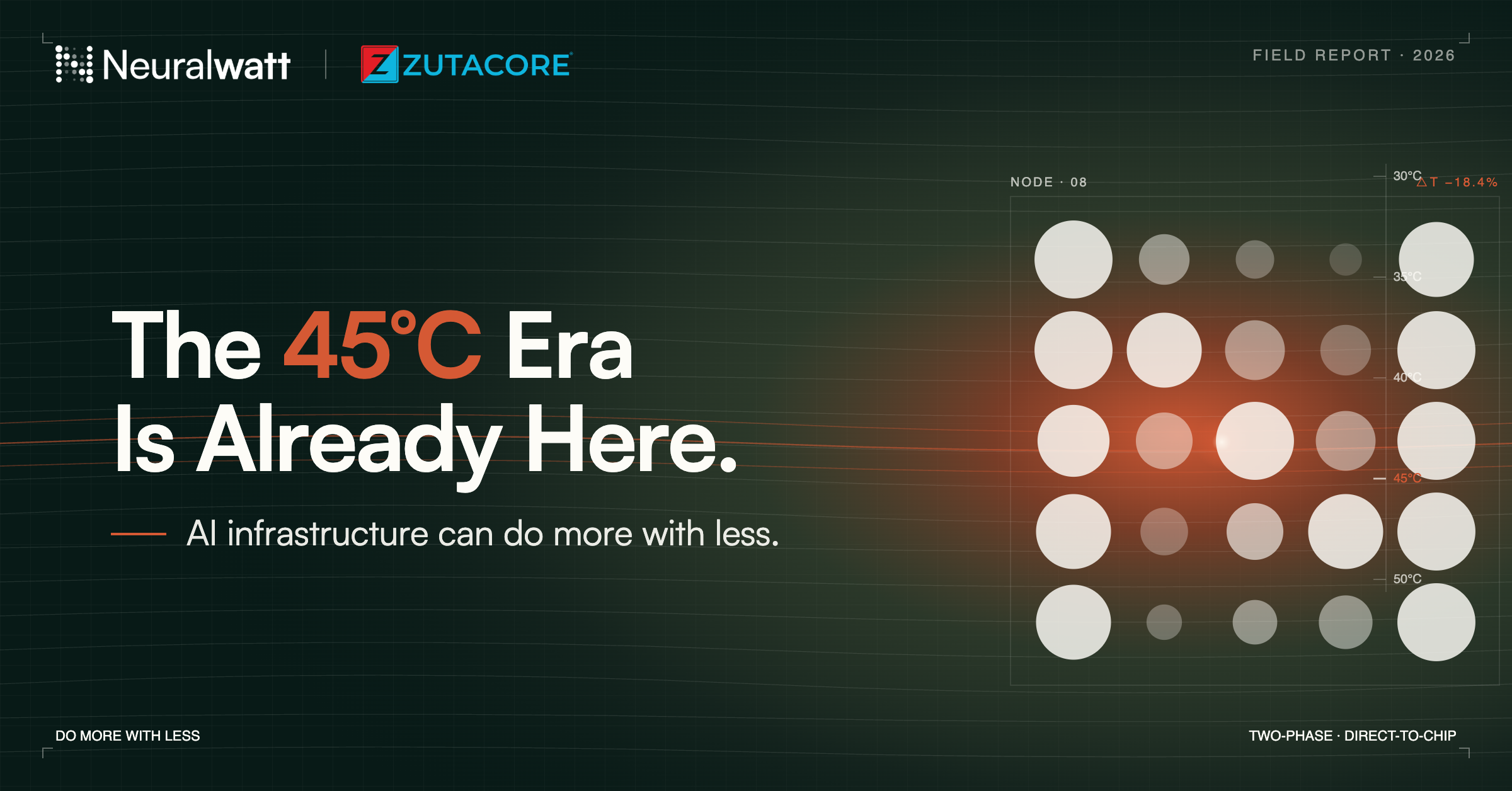
Neuralwatt, the leader in AI power optimization, today released findings from joint testing with ZutaCore, a pioneer in waterless direct-to-chip liquid cooling, showing that AI data centers can operate at 45°C warm-water temperatures on current-generation B200 hardware, effectively eliminating the need for energy-intensive mechanical cooling without sacrificing a single token of inference performance.
In what is one of the first combined compute and cooling optimization testing efforts in the industry, Neuralwatt and ZutaCore ran nearly 500 paired experiments on current-generation NVIDIA B200 hardware under real-world, high-intensity AI inference workloads. The results prove that current-generation hardware can operate at the warm-water temperatures the industry is moving toward.
The 45°C era is already here
At CES in January, Jensen Huang announced that NVIDIA's next-generation Vera Rubin platform is designed to operate with 45°C inlet water — warm enough to eliminate chillers in most climates and significantly reduce energy consumption and water use. The industry took note, but left many wondering whether the operating point is viable today, on hardware that is already running, or if it is something to prepare for in the next hardware cycle.
Results from Neuralwatt and ZutaCore testing confirm that 45°C warm-water operation is viable today, on hardware operators are already running. Across nearly 500 paired experiments at temperatures from 28°C to 46°C, the combined Neuralwatt and ZutaCore stack delivered:
- Zero thermal throttling across the entire tested range. ZutaCore's cooling keeps B200 GPUs within safe thermal limits at warm-water temperatures most operators have not attempted. The system does not throttle until 49°C, well above the 45°C industry target, giving operators meaningful room to operate.
- No performance penalty. With ZutaCore cooling and Neuralwatt's optimization agent working together, inference throughput at warm operating temperatures is statistically indistinguishable from the coolest tested point. Running hotter does not mean running slower.
With ZutaCore's cooling as the foundation, Neuralwatt's optimization agent delivered:
- Roughly triple the thermal buffer at 45°C compared to running without optimization. GPU memory temperatures stay approximately 6°C further from the throttle boundary, meaning the system is not just stable at 45°C, it has meaningful headroom to spare.
- An 18-19% reduction in server power consumption across every temperature tested, roughly 10x more impactful than any savings achievable through cooling adjustments alone. Because less server power means less heat to remove, those savings extend beyond the servers themselves. At typical operating efficiency, every 8-GPU system produces an estimated 6.3kW of total facility energy savings
- A 3x improvement in power stability, with variability dropping from 4.2% to 1.2%. AI workloads run more consistently, capacity planning becomes more reliable, and delivering on performance commitments gets meaningfully easier.
- Between 1.5°C and 7°C of effective thermal reduction depending on the workload, achieved through software optimization alone. This extends the safe operating range without any changes to physical infrastructure, giving operators more room to push hardware harder."
The path forward
AI is growing faster than the infrastructure built to support it. Global AI computing capacity has surged 3.3x per year, and power and thermal constraints are increasingly limiting how far organizations can scale. But the combined ZutaCore and Neuralwatt stack gives operators a concrete path to more compute, lower costs, and a smaller energy footprint without new hardware, new construction, or waiting on the next GPU generation.
Additional trials are underway, and the co-optimization opportunities between ZutaCore's cooling control and Neuralwatt's workload-aware agent represent a path to further gains.
The constraint on AI growth is no longer just compute, it is energy, thermal capacity, and the infrastructure built to support both. The industry has historically treated those as fixed constraints, but Neuralwatt and ZutaCore are proving that they are not.
About Neuralwatt
Neuralwatt is AI power optimization software that sits alongside existing infrastructure, measuring and optimizing energy at the workload level. By making every watt visible, measurable, and actionable, Neuralwatt helps organizations increase capacity, reduce costs, and lower carbon emissions — without new hardware or infrastructure changes. In production environments, customers have achieved 33 percent more compute from their existing power envelopes.
About ZutaCore
ZutaCore is a leader in waterless, direct-to-chip liquid cooling for AI and high-performance computing. Powered by its patented two-phase HyperCool technology, ZutaCore removes heat directly at the processor through a sealed, closed-loop system — eliminating water use, reducing cooling energy by up to 82%, and enabling significantly higher compute density.
For more information on the testing methodology and full results, contact meaghan@neuralwatt.com